What Is Jaggery?
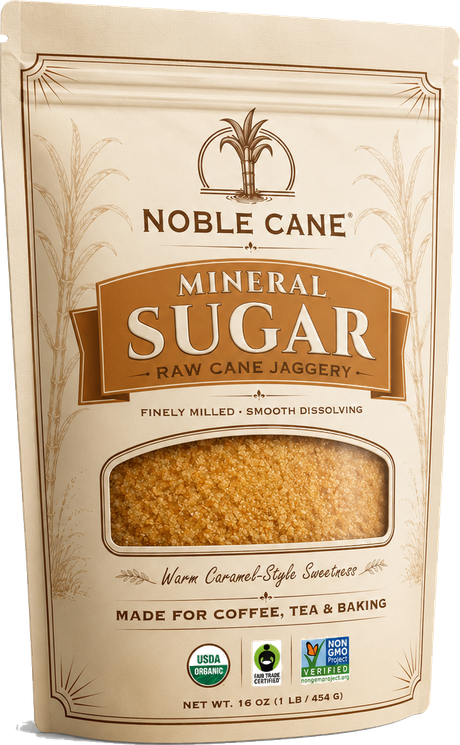
Jaggery is a traditional unrefined sugar made by evaporating raw cane juice without removing the molasses or minerals. The result is a golden-brown sweetener that retains iron, potassium, magnesium, and other trace minerals lost during conventional sugar refining. Noble Cane Mineral Sugar is stone-ground jaggery in a fine powder form.
How is jaggery made?
Fresh sugarcane is pressed to extract the juice. That juice is slowly boiled in large, open pans until it thickens into a dense, golden paste. No centrifuges, no chemical processing, no bleaching. The paste is cooled, hardened, and either sold as blocks or ground into powder.
Because jaggery skips the refining steps that strip white sugar of its nutrients, it keeps the natural molasses, minerals, and color from the original cane juice.
Jaggery nutrition
Jaggery retains minerals that white sugar processing removes, including iron, potassium, and magnesium.
A 20-gram serving of jaggery provides roughly 0.3 mg of iron (about 2% of the daily value), along with small amounts of potassium, calcium, magnesium, and phosphorus. White sugar provides none of these.
Jaggery is still sugar. Calorie for calorie, it is comparable to white sugar. The advantage is mineral retention, not calorie reduction.
Jaggery retains up to 50x more mineral content than refined white sugar — USDA FoodData Central
How to use jaggery powder
Jaggery powder dissolves easily in hot liquids. Stir it into coffee, tea, chai, or warm milk for a deep, caramel-like sweetness. It works in baking as a 1:1 replacement for brown sugar.
In South Asian and Southeast Asian cooking, jaggery is used in desserts, sauces, and savory dishes where its warmth and depth round out spice. It's also a staple in Ayurvedic preparations.
| Jaggery | White sugar | |
|---|---|---|
| Processing | Minimally processed | Heavily refined |
| Color | Golden brown | White |
| Minerals | Iron, potassium, magnesium | None |
| Flavor | Warm, caramel, molasses notes | Neutral sweet |
| Calories (per tsp) | ~15 | ~16 |
Quick answers
Is jaggery healthier than white sugar?
Jaggery retains minerals like iron and potassium that white sugar processing removes. Calorie-wise they are nearly identical. The benefit is mineral content, not calorie reduction.
What does jaggery taste like?
Warm, deep sweetness with caramel and light molasses notes. Less neutral than white sugar, more complex than brown sugar.
Can I use jaggery powder in coffee?
Yes. Jaggery powder dissolves easily in hot coffee and adds a warm, caramel sweetness.
Is jaggery the same as brown sugar?
No. Brown sugar is refined white sugar with molasses added back in. Jaggery is never refined in the first place, so its minerals are naturally intact.
Keep reading
Jaggery vs. Brown Sugar: What's the Difference?
Jaggery is unrefined cane sugar that retains its natural minerals and molasses. Brown sugar is refined white sugar with molasses added back in after processing. They look similar, but jaggery keeps iron, potassium, and magnesium that brown sugar loses during refining.
Read more →How to Use Jaggery in Coffee
Jaggery powder dissolves easily in hot coffee and adds a warm, caramel sweetness with depth that white sugar can't match. Use about 1 teaspoon of jaggery powder per cup. It pairs especially well with dark roasts, espresso, and chai lattes.
Read more →